· By WLAM
The sport polo: from a 1926 tennis court to choosing the right shirt for you

Today the polo shirt is everywhere: the office, the café, the golf course. But it started on the tennis court, as the answer to a very practical problem: the match clothes of the day were far too restrictive. Knowing that origin helps you choose a better sport polo.
The polo was born on the tennis court
In the 1920s, players usually took the court in long-sleeved shirts. René Lacoste, the French tennis player, found them stiff and uncomfortable. According to Wikipedia, he designed a white short-sleeved shirt in loosely knitted cotton piqué, with a soft unstarched collar, a buttoned placket and a back hem longer than the front, and wore it at the 1926 US Open.
From 1927, Lacoste embroidered a crocodile on the left chest, after the nickname the American press had given him. The shirt went on sale in 1933, and by 1951 it came in colors other than white. From match wear, the polo gradually became everyday wear.
How today's sport polo differs from a cotton polo
Cotton piqué breathes, but under hard effort cotton holds sweat. Modern sport polos usually use synthetics such as nylon or polyester blended with spandex: they wick sweat, dry fast and stretch with your movement. The trade-off is that synthetics hold odor more easily if washed the wrong way (see how to wash a sport polo).
4 things to check when choosing
1. Fabric composition
The spandex percentage tells you how much it stretches. For example, the 02W220 polo has 34.6% spandex, so it is very stretchy, while other WLAM polos sit at 9.7–18.2%. If the maker publishes test results (cool touch, UV protection, antibacterial), look at the numbers rather than the adjectives.
2. Fabric weight (g/m²)
Grams per square meter of fabric. Lighter fabric (around 150 g/m²) suits hot, sunny days; heavier fabric (around 190 g/m²) holds its shape better for the office.
3. Collar and placket
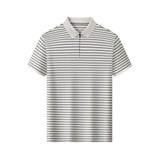
- Classic collar with button placket: the traditional look, right for both the golf course and the office. For example 02W218.
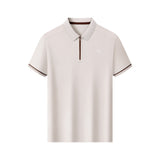
- Zip placket: zip up for a neat look, down for airflow. For example 02W223.
- Buttonless V-neck: an open neckline with a retro feel. For example 01W229.
- Hidden placket: a flat, clean front. For example 02W232.
4. Fit and size
- The shoulder seam sits right on the edge of your shoulder, not down on your upper arm.
- The body is long enough to cover your waistband when you raise your arm to swing.
- For a relaxed fit when moving, size up once.
Each style has its own measurements, so check the size guide before you order.
One shirt, two places
To wear it from court to street, choose neutral colors (white, black, cream, navy), a small logo and a matte fabric surface. That is also the idea behind WLAM polos: made for the court, worn in the city.